
In the years leading up to Kristallnacht, or The Night of Broken Glass, prejudice and hate toward the Jewish community grew to overwhelming levels in Nazi Germany.
In 1935, the Nuremberg Race Laws were introduced. These laws included the Reich Citizenship Law, which stripped Jews of German citizenship and made them stateless in their own country. As well as the Law for the Protection of German Blood and Honor, which banned marriage and sexual relationships between so-called Aryans (Germans) and Jews.
In 1938, anti-Jewish measures increased dramatically. In July, the Évian Conference took place. Thirty-two countries met to discuss the growing number of Jewish refugees fleeing Germany. All but the Dominican Republic refused to accept large numbers of Jewish refugees. This signaled to Hitler that the outside world would not intervene in Germany.
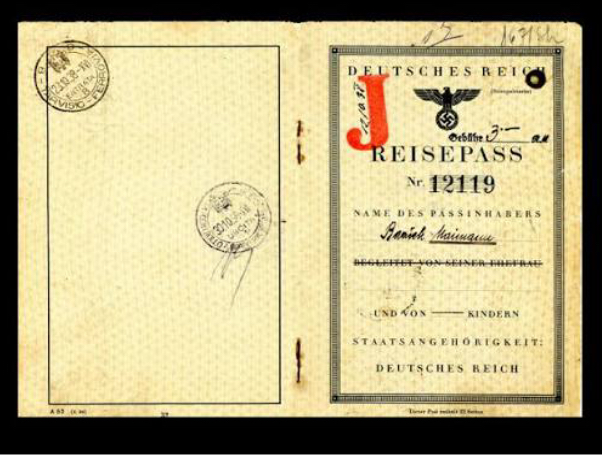
Around this time, forced naming laws and passport invalidation were also enacted. A new law required Jews who did not already have “Jewish” names to add “Israel” for men and “Sara” for women. Jewish passports were invalidated unless they were stamped with a red “J.”
On November 9, 1938, German diplomat Ernst vom Rath died from injuries sustained two days earlier after being shot by Herschel Grynszpan, a seventeen-year-old Polish Jewish refugee. When news of his death reached Hitler, intense discussions began. Hitler abruptly left the meeting without giving his usual address, leaving Joseph Goebbels, the Minister of Propaganda, to speak in his place.
Goebbels stated that “the Führer has decided that… demonstrations should not be prepared or organized by the Party, but insofar as they erupt spontaneously, they are not to be hampered.” This statement was understood as permission to attack Jewish homes, synagogues, schools, and businesses. The death of one man was used as an excuse to provoke widespread destruction, brutal beatings, and murder.
The Night of Broken Glass took place on November 9–10, 1938. Members of the Nazi Party’s Sturmabteilung (SA) and Schutzstaffel (SS), along with the Hitler Youth and German civilians, carried out a pogrom—a violent, organized riot against Jews. Jewish homes, schools, hospitals, synagogues, and businesses were broken into and destroyed. German police often stood by and allowed the violence to happen, and in some cases even participated.
During the pogrom, more than 1,400 synagogues and prayer rooms across Germany, Austria, and the Sudetenland were burned. Over 7,000 Jewish businesses were destroyed, leaving shattered glass covering the streets. This is where the name Kristallnacht comes from—it translates to “Crystal Night,” or The Night of Broken Glass.
Jewish families were forced to watch as sacred books and personal belongings were burned in massive fires. Nearly 30,000 Jewish men were arrested and sent to concentration camps.
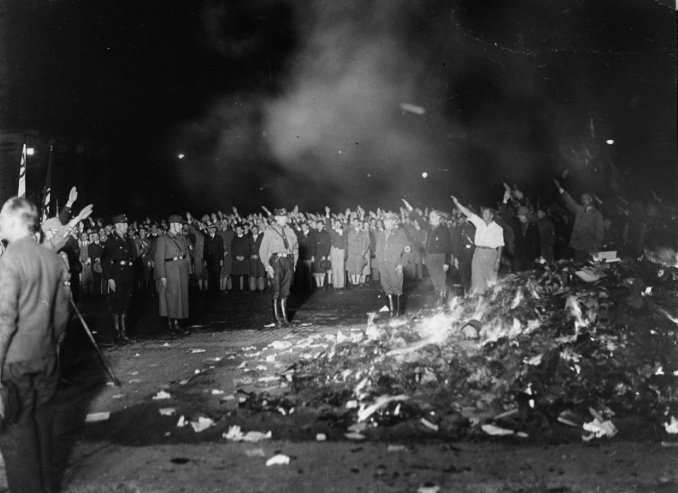
On November 11, 1938, The Times of London wrote: “No foreign propagandist bent upon blackening Germany before the world could outdo the tale of burnings and beatings, of blackguardly assaults on defenseless and innocent people, which disgraced that country yesterday.”
This statement meant that the violence of Kristallnacht was worse than anything even the harshest propaganda could have portrayed.
Early estimates reported that 91 Jews were murdered during Kristallnacht, but modern historical research suggests the death toll was much higher. When deaths caused by post-arrest abuse, imprisonment, and later suicides are included, the total reaches into the hundreds. Historian Richard J. Evans estimates that 638 Jews died by suicide alone as a result of the pogrom and its aftermath.

Emily O’Brien is an 8th grade student at Shaler Area Middle School and a writer for the SAMS Salmon. She enjoys Reading Fantasy, historical fiction, and dystopian books and writing stories. She plays Hockey, Soccer, Wrestling, and Track and Field for the middle school and club teams. She also enjoys listening to music, acting, knitting, baking, and hanging out with her friends and girlfriend in her free time.
 The SAMS Salmon